Executive Summary
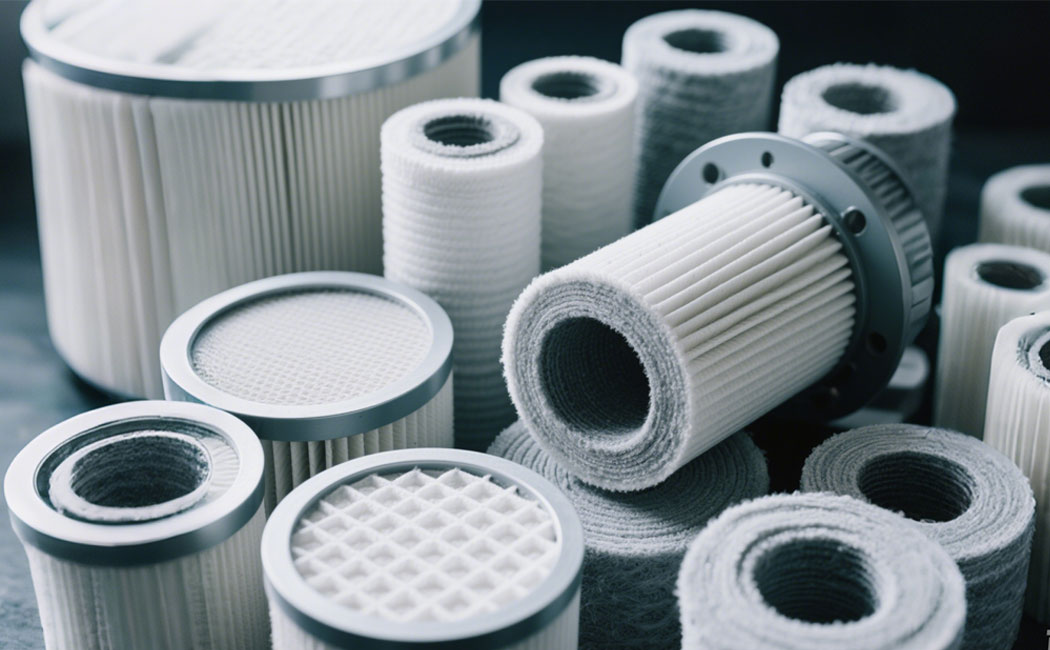
In the booming global filtration industry, the global air filter market is expected to reach US$ 186.6 billion in 2025 alone, of which the industrial air and gas filtration market segment accounts for 69.9% of the total industrial filtration market. Medium-sized manufacturers are looking for a cost-effective and flexible solutions to balance efficiency and customization. A simple supporting production line has become a game changer, making up the gap between manual operations and fully automatic large filter production line. In this paper, the core value, specifications, applications and practical opinions of simple matching production line for filter manufacturing are discussed in depth, and based on authoritative data and industry practices.
1.Definition: What is the simple supporting production line for filter manufacturing?
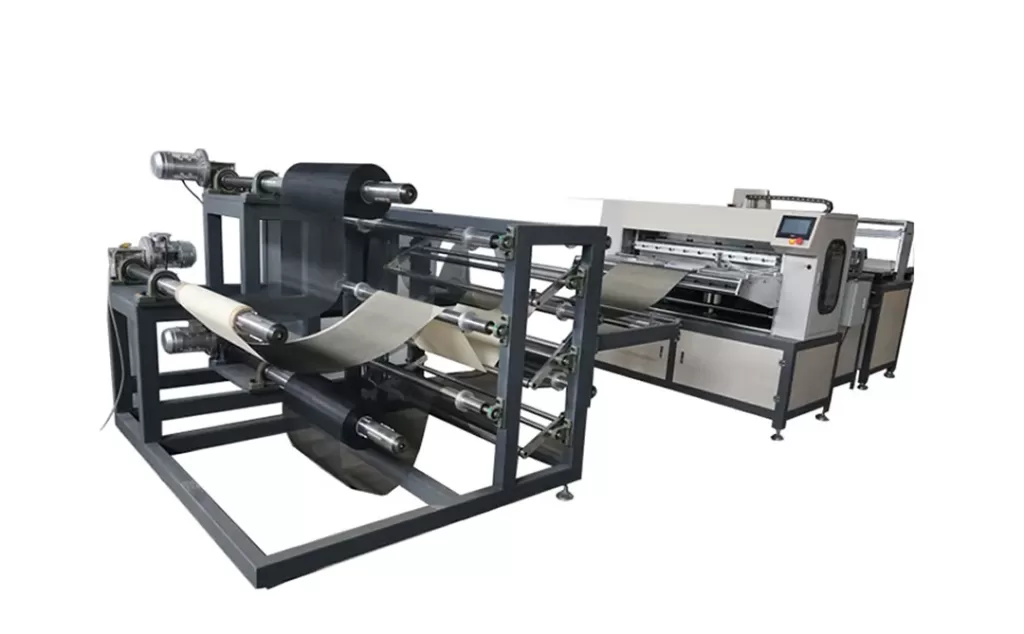
Simple matching production line for filter manufacturing refers to a modular and moderately automated production system, which is used to assemble, process and preparing filter media and components. Different from the complex automatic production lines, it gives priority to flexibility and simplicity, and allows customization according to product structure, material characteristics and output requirements without complicated configuration. It integrates core filter manufacturing equipment such as pleating machines, longitudinal slitting machines, and cross-cutting machine into a streamlined workflow, ideal for small to medium-scale production environments.
This type of production line conforms to the concept of “simple production”, emphasizing minimizing complexity, optimizing resource allocation and reducing waste, in order to improve efficiency and ensure product quality. It differs from mass-production lines by focusing on medium throughput and flexible layout adjustments, making it a preferred choice for manufacturers with diverse product portfolios.
2.Unique Advantages of the Simple Matching Production Line
The simple matching production line stands out in the filtration equipment market, because it has four core advantages, which are tailored for the medium-scale demand :
- Flexible Configuration options: Modular layout is adopted, and the production line supports filter manufacturing equipment (for example, material rack, folding machine, longitudinal slitting machine and cross-cutting machine) based on product type and production volume. This flexibility enables manufacturers to switch between different filter production tasks without having to overhaul the entire production line.
- Simplified workflow integration: By connecting multiple devices into a coherent sequence, manual treatment is minimized, and the consistent output and quality in the filter production stages are ensured. Compared with discrete manual operation, this integration reduces human error and improves the efficiency of workflow.
- Industrial-grade durability: Each integrated machine is designed for harsh factory conditions and is equipped with robust components to ensure consistent and reliable performance under continuous use. This level of durability reduces maintenance costs and extends the life of the production line–an important factor for cost-conscious mid-size plants.
- User-friendly operation: The production line has user-friendly control system (touch screen HMI, PLC automation and safety interlock), which simplifies the training of operators and minimizes operation errors. Even employees with little technical knowledge can master the operation quickly, thus reducing labor costs.
3. Product specifications and typical configurations
The simple matching production line for filter manufacturing is specially designed for medium output (suitable for 500-2,000 units per shift), supporting a variety of filter media and components. According to the standard process-discharging → folding → longitudinal cutting → transverse cutting-the following table introduces four kinds of core single equipment configurations and their functions in the production line in detail:
| Configuration Number | Core Filter Manufacturing Equipment | Equipment Functions and Workflow Roles |
| Configuration 1 | Material Rack | A basic rack for holding filter materials (e.g., filter media rolls), providing stable and continuous material supply for subsequent folding processes. |
| Configuration 2 | CNC Folding Machine | Receive materials from the material rack, perform precise pleating/folding on filter media to form the core structure of filters. |
| Configuration 3 | Longitudinal Slitting Machine | Process folded filter media, slit it into uniform strips along the longitudinal direction to meet the width requirement of filter blanks. |
| Configuration 4 | Cross-Cutting Machine | Cut the longitudinally slit filter strips into individual pieces of specified size, completing the blank forming of filter elements. |
These four configurations can be seamlessly connected to form a complete Air Filter Production Line, with each piece of equipment supporting PLC automation control and safety interlock systems. Parameters such as folding density, cutting width and cutting size can be adjusted to meet different filter specifications. The combined line cover an area ranging from 5 to 15 square meters, which is suitable for small and medium-sized enterprises with limited factory space.
4.Operation Steps of the Simple Matching Production Line
Based on standard filter production process and modular design of production line, the operation steps are simplified into four core stages :
- Device selection and layout: According to the target filter type (for example. HVAC air filters used in air filter production line), select the corresponding filter manufacturing equipment combination, and arrange modules in a logical workflow to minimize material transmission distance.
- Parameter setting and debugging: Set the parameters (pleat width, cutting length, bonding temperature) according to the filter specifications by using the touch screen man-machine interface. Carry out trial operation to adjust the coordination of equipment and ensure product accuracy.
- Continuous Production: Raw materials (filter media, metal mesh) are input into the production line. The integrated system can automatically finish pleating, cutting, bonding and stacking. Operators only need to monitor the workflow and deal with anomalies, reducing human intervention.
- Quality Inspection & Adjustment: Conduct in-line quality checks on finished products (e. Fold uniformity, adhesion firmness). If there is deviation, adjust parameters in real time to ensure the consistent quality of each batches.
5.The main application scenarios
The Simple Matching Production Line for Filter Manufacturing is widely used in scenarios requiring medium throughput and flexible production, perfectly matching the needs of medium-scale manufacturers in the following fields :
- HVAC Industry: The ideal choice for producing HVAC air filters to meet the growing demand for improving indoor air quality. As the fastest growing regional market, the Asia-Pacific region is pushing the huge demand for economical and efficient air filter production line solutions, and China accounts for more than 50% of the HVAC filter market in the region.
- Automobile Industry: Suitable for assembling automobile engine room and engine air filters to meet the customized requirements of different models.
- Industrial Dust Collection: Used in manufacturing industrial dust collector filters, helping factories comply with strict environmental protection regulations.
- Commercial filtration: Suitable for commercial filter media components, such as filters for shopping malls, hospitals, office buildings, etc.
6.Frequently asked questions about simple supporting production line for filter manufacturing
Q1: What does a simple matching production line include?
A1: It consists of several connected filter manufacturing equipments, such as pleating, slitting, cutting and bonding equipment, which are integrated into a coherent workflow. The combination can be customized based on production needs, a typical feature of modular filtration production systems supported by industry research (Source: https://www.jenrs.com/publications/JENRS_0107005.pdf).
Q2: Can this line be customized?
A2: Yes, the modular design allows customization of equipment parameters and layout according to product specifications (size, material and structure) and production capacity, and supports multiple filter types.
Q3: Is it suitable for high-volume production?
A3: It is designed for medium throughput. For very large-scale production (more than 5,000 pieces per shift), it is recommended to use a fully automatic large-scale production lines, which performs well in medium-scale and multi-sku production.
Q4:How long does it take for the installation and commissioning of the production line?
A4: The modular structure makes it possible to install quickly, which usually taking 3-7 days. Debugging and operator training can be completed within 2-3 days, minimizing production downtime.
7.Summarize
With the growth of the global filtration industry, the modular filter production line has become an indispensable tool for medium-sized manufacturers, offering an optimal balance between flexibility, cost-effectiveness and efficiency. Its modular design, ease of use and compatibility with various applications will help solve the key challenges faced by small and medium-sized companies: reducing labor costs, improving product consistency and adapting to market changes.For manufacturers who want to update their air filter production line or expand their product range, the production line provides a reliable solution, avoiding the high costs of fully automatic systems and meeting industrial quality standards at the same time.